
Korea Transfer Discount — Here’s Exactly How It Works
Korea’s public transit has a hidden savings system every foreigner must know — the transfer discount.
When you switch from bus to subway, or subway to bus, you can continue your journey with no extra charge — if you meet the conditions.
But there’s one rule you must follow to receive this benefit — tapping your card when you get off.
This post breaks down exactly how the transfer discount works, what mistakes will cost you extra, and how to use it right — explained simply for foreigners.
Even Hongdae Andy lost money a few times when first arriving in Korea because of this system. Read this now and you won’t have to make the same mistake.
What We’ll Cover Today
- What is the transfer discount?
- Key rule: always tap off when exiting
- Transfer time window and regional differences
- Transit card types, how to buy and recharge
- Common mistakes and how to fix them
What Is the Transfer Discount?

Korea’s transfer discount is a system where you’re charged only once when using two or more modes of transport in a row.
For example, if you get off a bus near a subway station and board the subway within 30 minutes, your fare is calculated based on the total distance traveled — not charged twice.
In other words, instead of paying a bus base fare + subway base fare separately, you pay one combined fare based on your total travel distance.
Thanks to this system, in a big city like Seoul you can freely switch between buses and subways while keeping your fare costs much lower.
The Most Important Rule: Always Tap Off

The most common mistake with the transfer discount is not tapping your card when getting off the bus.
On buses, you must tap at both boarding (front door) and exiting (rear door). On subways, the turnstile handles both entry and exit automatically.
If you don’t tap when exiting the bus, two problems occur.
First, the transfer discount won’t apply, and you’ll be charged a full base fare on your next ride.
Second, from March 2026 in Seoul, cards with no exit record are flagged by the system, and an extra charge is added on your next boarding.
Generally, when the rear-door reader beeps and shows a green light, your tap was successful. If there’s no sound, try tapping again.
Transfer Time Window and Regional Differences
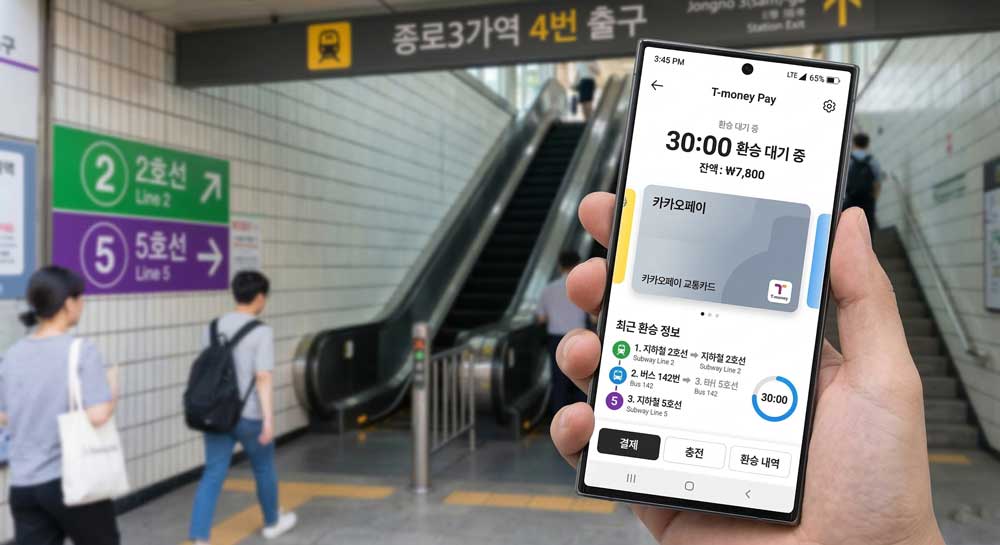
For the transfer discount to apply, you must board the next transport within a set time after exiting the previous one.
Refer to the table below.
| Region | Transfer Window | Max Transfers |
|---|---|---|
| Seoul Metro Area | 30 min (60 min late night) | Up to 5 times |
| Busan | 30분 / 30 min | Up to 2 times |
| Daegu | 30분 / 30 min | Up to 2 times |
| Gwangju·Ulsan | 30 min from exit time | Practically 1–2 times |
The Seoul metro area has the most favorable conditions. Get off a bus and board a subway within 30 minutes, or exit a subway and board a bus within 30 minutes — the discount applies automatically.
During late-night hours (generally after 9 PM), the transfer window extends to 60 minutes in parts of the Seoul metro area.
However, if you board the same route again, the transfer discount does not apply.
Transit Card Types, How to Buy and Recharge
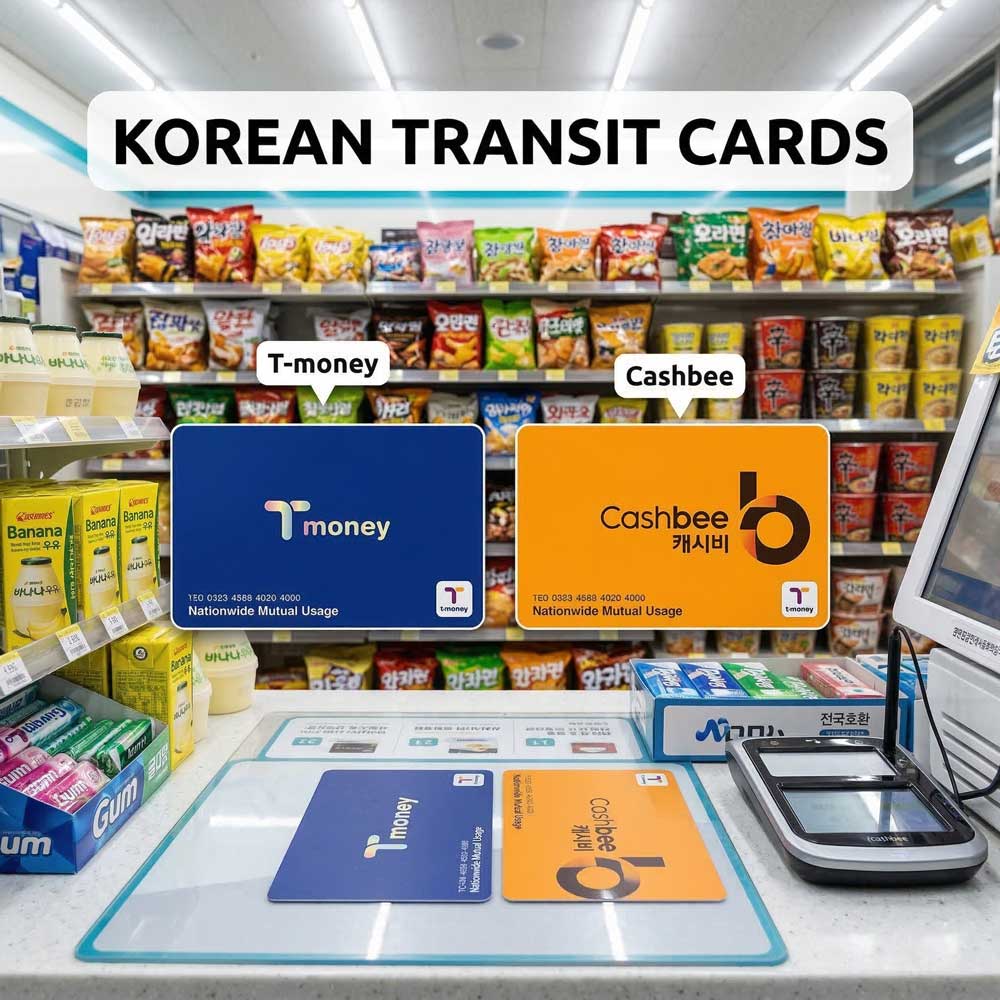
To receive the transfer discount, you must use a transit card. Paying with cash on buses or subways means no transfer discount at all.
Currently, there are two cards foreigners can most easily get.
T-money: Usable across Seoul, the metro area, and most of the country. Available at convenience stores like GS25, CU, and Emart24 for around ₩2,500.
Cashbee: Widely usable in regional cities like Busan, Daegu, and Gwangju. Also available at convenience stores.
Recharging is done at convenience store counters or subway station recharge machines. Minimum top-up is ₩1,000, and if your balance is insufficient, you’ll be denied boarding.
One important note: one card cannot be used to get transfer discounts for multiple people. Each person must use their own card.
Understanding Bus Colors and Their Roles
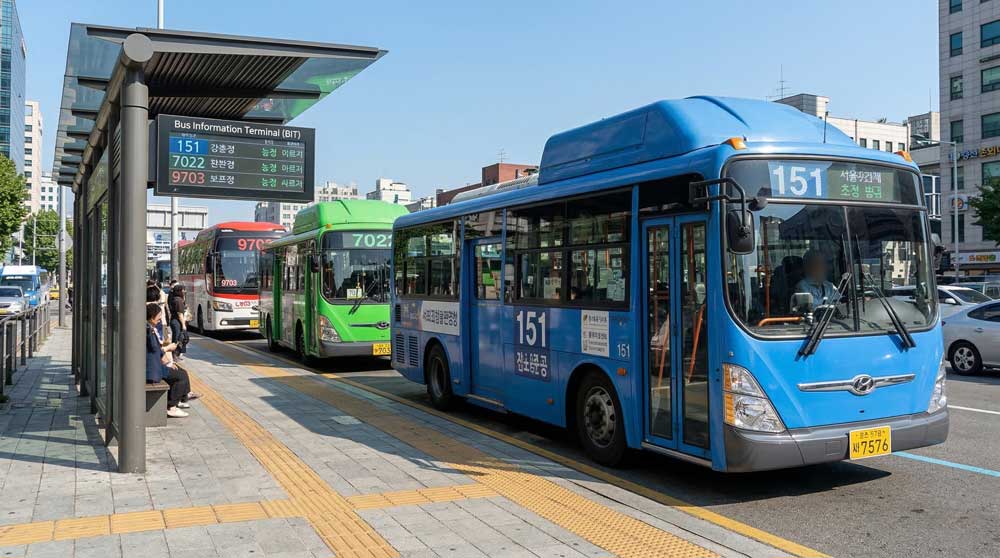
Knowing bus colors makes it much easier to plan your transfers.
| Color | Type | Feature |
|---|---|---|
| Blue | Trunk-line bus | Connects major city routes |
| Green | Branch-line bus | Short-distance, connects to subway |
| Red | Express bus | Seoul↔Gyeonggi long-distance |
| Yellow | 순환버스 / Circular bus | Seoul city center loop |
| Village bus | Mini route | Connects narrow local streets |
Green buses often connect to subway stations, making them a common last-leg option before boarding the subway.
The transfer discount applies between all these bus types and the subway. Note that express buses (red) have a higher base fare.
5 Common Mistakes and How to Fix Them
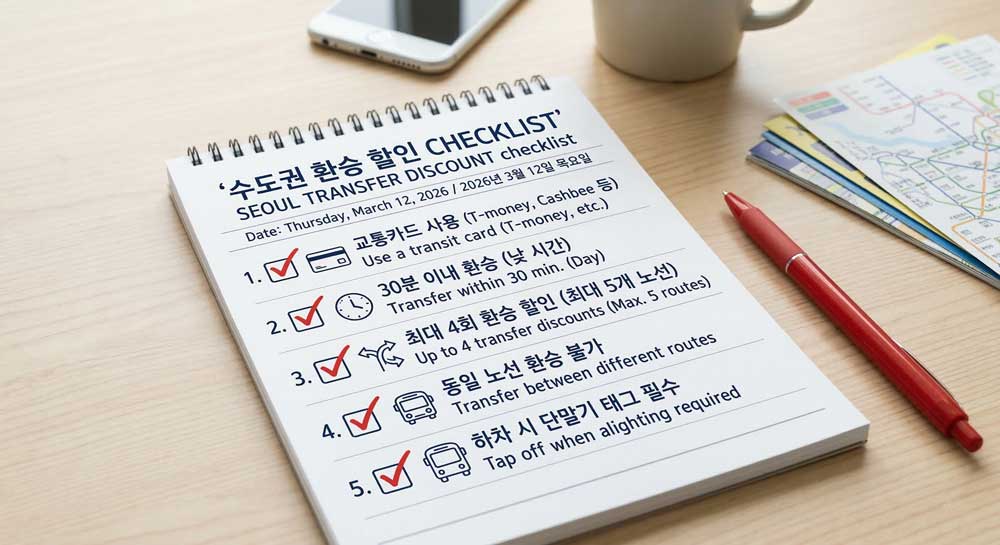
From common questions I hear in the field, foreigners tend to make the same 5 mistakes repeatedly.
✅ Transfer Discount Mistake Prevention Checklist
| Mistake | Result | Fix |
|---|---|---|
| Not tapping off the bus | No discount + extra charge next ride | Always tap rear-door reader |
| Paying bus fare with cash | Zero transfer discount | Always use transit card |
| Transferring after 30 minutes | New base fare charged | Plan with time buffer |
| Tapping one card for multiple people | No discount from 2nd person | Each person uses own card |
| Re-boarding the same route | Discount not applied | Transfer to a different route |
The most common mistake by far is not tapping off the bus. Once you build the habit of tapping the rear-door reader when exiting, the rest takes care of itself.
Recommended Apps: Use These for Navigation
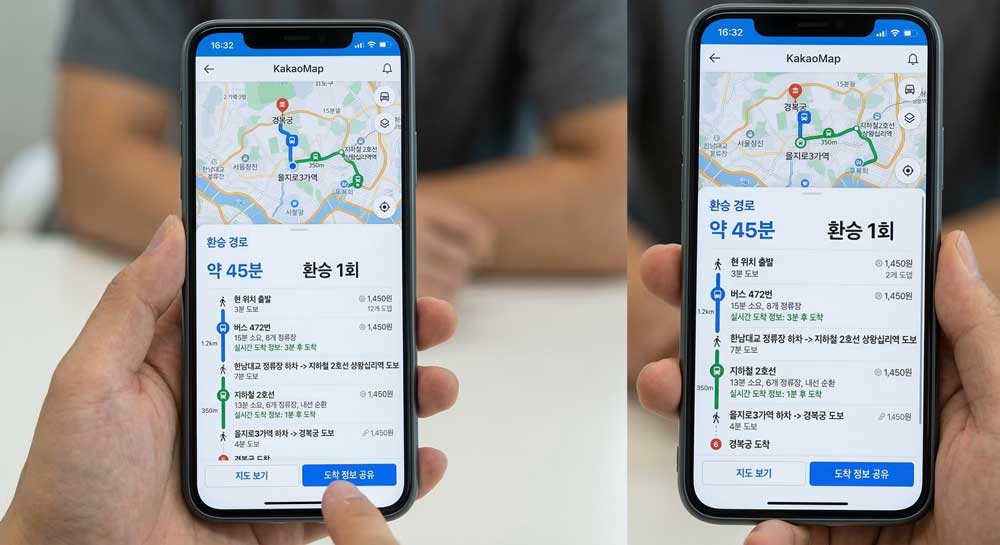
If you want to check your transfer route in advance, here are two apps to use.
Kakao Map: Shows real-time bus and subway transfer routes. It also displays the estimated fare, so you can immediately see how much you’re saving.
Naver Map: Supports an English interface, making it easier for foreigners. It also shows bus arrival times and transfer timing.
Both apps are free and available on the App Store and Google Play. I’d recommend installing them before your trip to Korea.
You can also find other Korea transit info (like Ttareungyi bikes and the Climate Card) right here on this blog — check those out too.
Step-by-Step Transfer Usage Guide
Follow these steps in order and you won’t miss the transfer discount.
| Step | Action | Key Point |
|---|---|---|
| 1 | Check card balance | Keep at least ₩2,000 |
| 2 | Tap front-door reader when boarding bus | Confirm beep sound |
| 3 | Tap rear-door reader when exiting bus | Most critical step |
| 4 | Board next transport within 30 minutes | Move with time to spare |
| 5 | Pass through subway turnstile when exiting | Handled automatically |
Once these 5 steps feel natural, you can move efficiently anywhere in Seoul.
FAQ
Q1. Can I get the transfer discount if I pay cash on the bus?
No, the transfer discount only applies when using a transit card. There is no discount at all for cash payments.
Q2. I forgot to tap off the bus. What should I do?
Do not go back on the bus to tap — it’s dangerous and not recommended. Just accept that the next ride will be charged a new base fare. The key is building the habit of tapping off every time going forward.
Q3. Where can I buy a T-money card?
You can buy one at convenience stores like GS25, CU, 7-Eleven, and Emart24 for around ₩2,500. Recharging is also available at the same stores.
Q4. Does the transfer discount work in cities other than Seoul?
Yes, transfer discounts apply in major cities like Busan, Daegu, and Gwangju too. However, the number of allowed transfers and time conditions vary by city, so check the local transit app or official website before you go.
Q5. How much can I actually save with the transfer discount?
The standard bus base fare is around ₩1,400. With the transfer discount, you don’t pay a new base fare on the second transport. If you transfer multiple times a day, savings can range from a few hundred won to over ₩1,000.
Q6. What happens if my transit card balance is too low?
You’ll be denied boarding if your balance is insufficient. Some cards may allow a small negative balance, but generally it’s safer to top up in advance.
With one transit card and these rules in mind, Korea’s public transit is far easier and cheaper than you’d expect. In the next post, I’ll break down how to read Seoul’s subway map and find transfer stations like a pro.