
Have you ever stood at a Korean mart or convenience store checkout and heard the cashier ask, “Would you like a bag?”
Many foreigners say “yes” assuming it’s free — then get surprised when 100–200 won is added to the total.
This isn’t a mistake. Korea’s bag fee is a legally mandated environmental policy.
Knowing this rule before you shop in Korea means no awkward surprises at checkout.
Let me go through the reasons behind the fee, the prices, and how to shop smart — one by one below.
What We’ll Cover Today
- Why Korea started charging for bags
- Bag prices by mart and convenience store
- Types of bags you can buy
- Practical tips for bringing your own bag
- 5 common mistakes foreigners make

Why Korea Started Charging for Bags
Korea banned single-use plastic bags at large marts and department stores starting in 2019.
Even before that, a paid-bag policy existed — but from 2019, the rule became “don’t sell them, don’t give them for free.”
Then in November 2022, the regulation expanded to convenience stores, bakeries, and general retail shops.
This is a policy the Ministry of Environment has been gradually strengthening to reduce plastic waste.
Giving out plastic bags for free in Korea is now illegal. Violations can result in fines of up to 3 million won.
Bag Prices at Marts and Convenience Stores
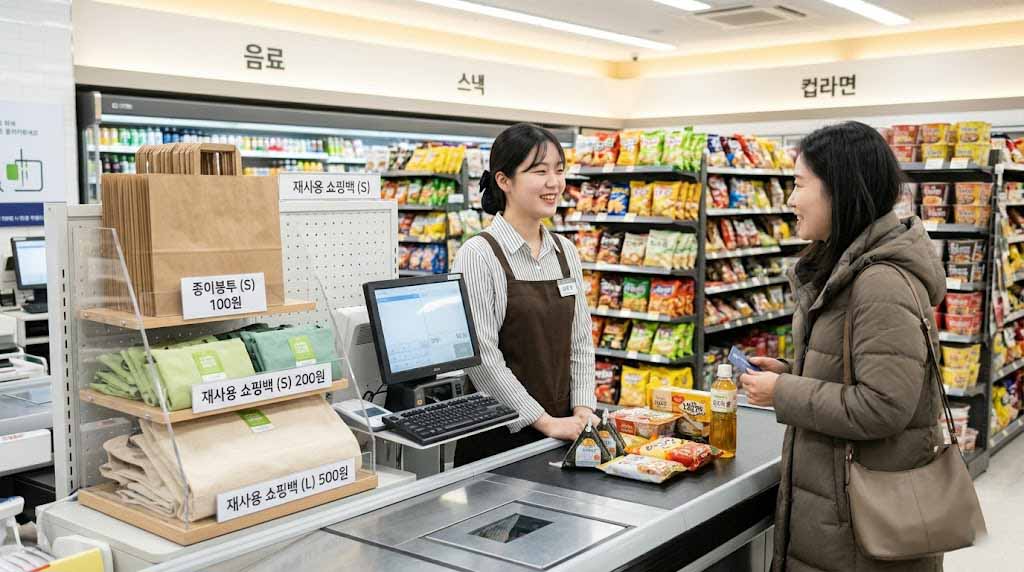
Bag prices vary slightly by store. They usually range from 100 to 500 won.
A lot of people ask — “So can’t I buy a plastic bag at all?” The truth is, you can still buy paper bags or reusable bags.
At large marts like E-Mart, Lotte Mart, and HomePlus, plastic bags are completely banned. Instead, you can buy paper bags (100–200 won) or reusable bags (500–1,000 won).
At convenience stores like GS25, CU, and 7-Eleven, paper bags cost around 100–250 won. Reusable bags are usually 500 won.
There’s a question I hear often — “Why do bag prices differ between convenience stores?” Each brand sets its own price. The law only sets a minimum; there’s no upper limit.
Types of Bags You Can Buy
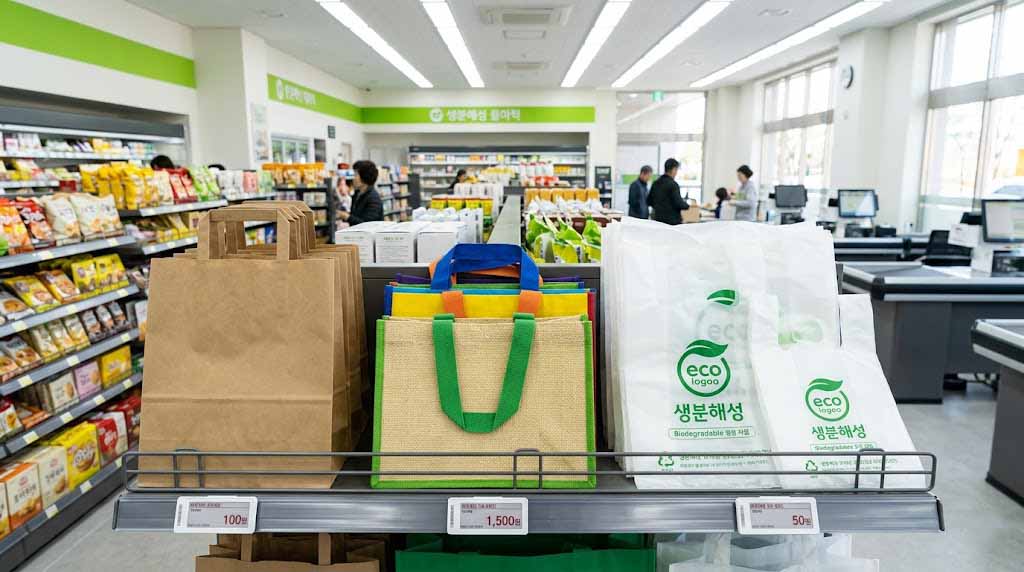
There are three main types of bags you can buy at Korean marts and convenience stores.
First is the paper bag. The most commonly available option, usually priced at 100–200 won. Great for light loads.
Second is the reusable bag (tote-style). Usually 500–1,000 won. Durable and reusable — great for frequent shoppers.
Third is the biodegradable bag. Only sold at select marts, slightly more expensive. A choice for those who care more about the environment.
Plastic bags are no longer available for purchase. Keep this in mind.
Practical Tips for Bringing Your Own Bag
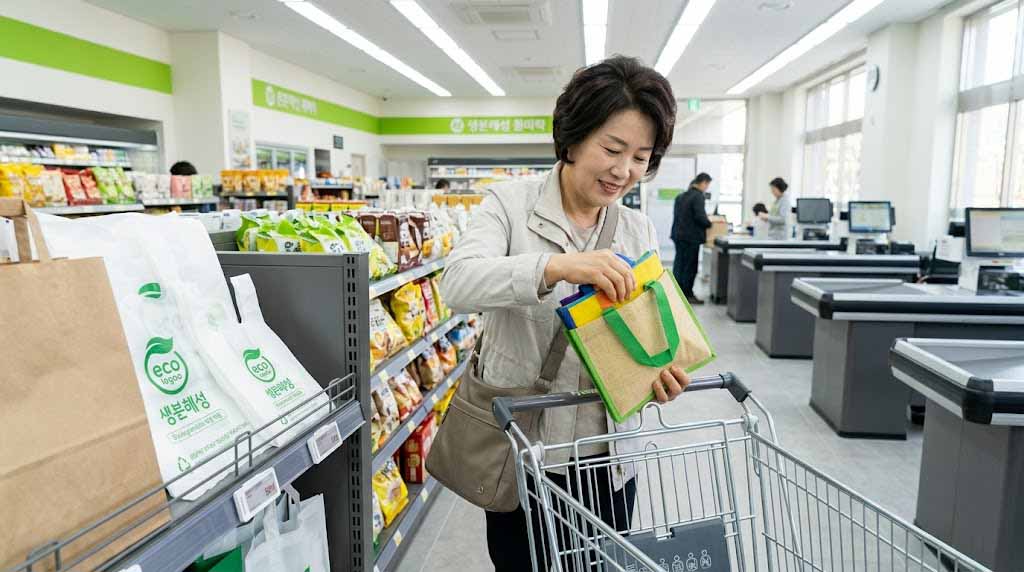
Honestly, most Korean locals bring their own reusable bag in advance.
Keeping a foldable tote bag inside your bag when heading to the mart has become a basic habit here.
Here’s a step-by-step breakdown of practical tips.
Step 1: If you’re planning to visit a Korean mart or convenience store, put a foldable eco bag in your bag in advance. It’s compact and light.
Step 2: If you’re only buying 1–2 drinks at a convenience store, it’s faster to carry them by hand. Just say “봉투 필요 없어요” (I don’t need a bag) at the checkout.
Step 3: If you’re planning a big grocery run, buy a reusable bag (500–1,000 won) at the mart entrance. Buy it once and use it again and again.
Step 4: Bags are also paid at stores like Daiso and Olive Young. Getting into the habit of carrying an eco bag makes things easy everywhere.
5 Common Mistakes Foreigners Make
There are common mistakes that happen when you shop in Korea without knowing about the bag fee. Knowing them in advance makes things much easier.
Mistake 1 — Assuming a bag will just be given
Waiting for a bag after checkout and getting nothing can be confusing. You need to request a bag and pay for it.
Mistake 2 — Assuming bag prices are the same everywhere
Bag prices in Korea vary by store. Convenience stores charge 100–250 won; marts range from 100 to 1,000 won.
Mistake 3 — Trying to buy a plastic bag
Regular plastic bags are no longer sold. Only paper bags or reusable bags are available.
Mistake 4 — Thinking small stores give bags for free
Regardless of size, bags are paid at most retail stores. Small neighborhood supermarkets are no exception.
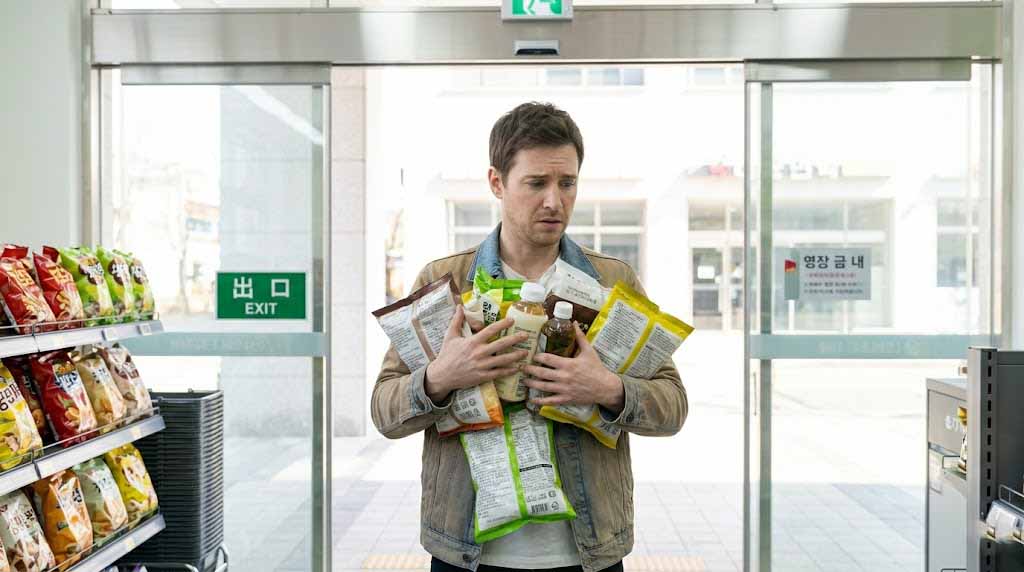
Mistake 5 — Leaving without a bag and struggling to carry items
One eco bag solves all of this. A foldable eco bag is compact enough to keep in your bag at all times.
Korea Bag Fee Summary Checklist
Just check these before shopping at a Korean mart or convenience store.
- Plastic bags are banned — only paper or reusable bags are available.
- Bag prices range from 100–500 won — varies slightly by store.
- If you don’t want a bag, just say “봉투 필요 없어요.”
- One foldable eco bag in your bag is the easiest solution.
- Daiso, Olive Young, pharmacies — bags are paid at most retail stores too.
If you’re curious about Korean shopping culture, check out our [Complete Guide to Korean Convenience Stores] too. It covers what to buy and how to pay — from the very beginning.
For more tips on grocery shopping at Korean marts, you can find more details in our [Korean Mart Shopping Guide].
Korea’s bag fee feels unfamiliar at first, but it’s actually a very simple rule.
One foldable eco bag in your bag means you can shop anywhere without worrying about a bag fee.
In the next post, I’ll put together a list of must-buy products at Korean marts — things Korean locals actually buy regularly.